
Thanksgiving is one of my favorite holidays and is an American tradition. In elementary school, I remember studying the pilgrims and that they landed at a place in the fall of 1620. I faintly remember learning they knelt near a rock and gave thanks to God for this, their new place to live. They named it Plymouth. I’ve learned more since then–about a certain character whose name was Squanto.
From Governor William Bradford’s writing, Squanto came into view in the spring of 1621 accompanied by Chief Massasoit. They told the pilgrims they were in a place they called Patuxet.
Bradford wrote that Squanto spoke English very well, was friendly, and stayed with them. He showed them basic skills like using beaver skin for clothing, how to fish a certain brook in early spring where fish came to spawn, and how to plant corn along with a fish for fertilizer.
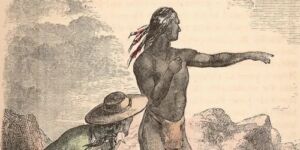
Let’s look at what we know about Squanto before he met the pilgrims in 1621. In 1605, Squanto was one of five natives in the area we know as New England and kidnapped by Captain Weymouth. Was brought to England where he met Shakespeare and his benefactor, the Earl of Southampton. Squanto lived in Plymouth, England and learned the English language. In 1614, he sailed back to New England as an interpreter and returned to his tribe, the Patuxets. Later that year, he was kidnapped again and this time, taken to Spain where he was most likely rescued by Catholic friars and introduced to Christian concepts. Eventually, the friars gave him his freedom. He returned to England and there he worked until 1619 when he returned to his home place. He found his tribe was completely gone and learned they had all died of a plague.
The first winter, about half of the pilgrims died. It was a real possibility that they would not have survived another winter had it not been for Squanto’s friendship. Bradford said: “Squanto … was a special instrument sent of God for their good beyond their expectation.”
Who knows what might have happened if Squanto had not been kidnapped? First, he learned the English language and apparently had affection for the English. After his return to his homeland he was kidnapped again and although it’s hard to understand why once again he was kidnapped, most likely he would have died of the same plague. As well, in his second kidnapping, he wouldn’t have been exposed to the Christian faith by the Catholic friars in Spain. Credit: Bill Federer.
In September of 1622, Governor Bradford wrote:
|

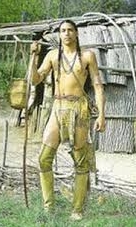
Here Squanto fell ill of Indian fever, bleeding much at the nose, which the Indians take for a symptom of death, and within a few days he died.
He begged the Governor to pray for him, that he might go to the Englishmen’s God in Heaven, and bequeathed several of his things to some of his English friends, as remembrances.
His death was a great loss.
To summarize, here are a few pertinent dates:
♥1605, Squanto was kidnapped, taken to England where he learned the English language.
♥1614, Squanto returned to Patuxet and his tribe, but then kidnapped again and taken to Spain. There he learned about the Christian faith.
♥1619 Squanto returned again to Patuxet and discovered all of his tribe were gone–killed by a plague.
♥1621 Squanto befriends the pilgrims and teaches them necessary survival skills in their new country.
♥1622 Squanto dies of a plague, but prays to the Englishman’s God that he might go to heaven.
Governor Bradford summarizes Squanto’s life by this statement: “Squanto … was a special instrument sent of God for their good beyond their expectation.”
I like what the psalmist says:
O Lord, you have examined my heart
and know everything about me.
2 You know when I sit down or stand up.
You know my thoughts even when I’m far away.
3 You see me when I travel
and when I rest at home.
You know everything I do.
4 You know what I am going to say
even before I say it, Lord.
5 You go before me and follow me.
You place your hand of blessing on my head.
6 Such knowledge is too wonderful for me,
too great for me to understand! (Psalm 139:1-6 NLT).
What about you? God has placed you here, right now, for such a time. Who are you influencing? What will people say about you when you are gone? Reading about Squanto makes me appreciate who I might be influencing by my words and what I do with my time.
You might consider using this Squanto story at your own Thanksgiving table this season.
“Father God, I thank you for knowing me. That you love me and placed me in this very place for such a time as this. I thank you for using Squanto to help establish our country. Please use me in my sphere of influence. In the name of our Resurrected Jesus, amen.”
Get these Blog posts emailed directly to you.
Here’s a thanksgiving song to think about until we celebrate our Thanksgiving Day, November 27. Enjoy.




Wonderful & timely post Shirley. Thank you – I’d never heard the story before.
The song had special meaning for me with what I’ve been going through the past 2 1/2 months ‘ couldn’t have come at a better time!
Judy, we pray together, before I begin to write the blog that it will touch someone somehow. It sounds like yesterday was for you! Love, shirley